

Overview
How this machine carries the load.
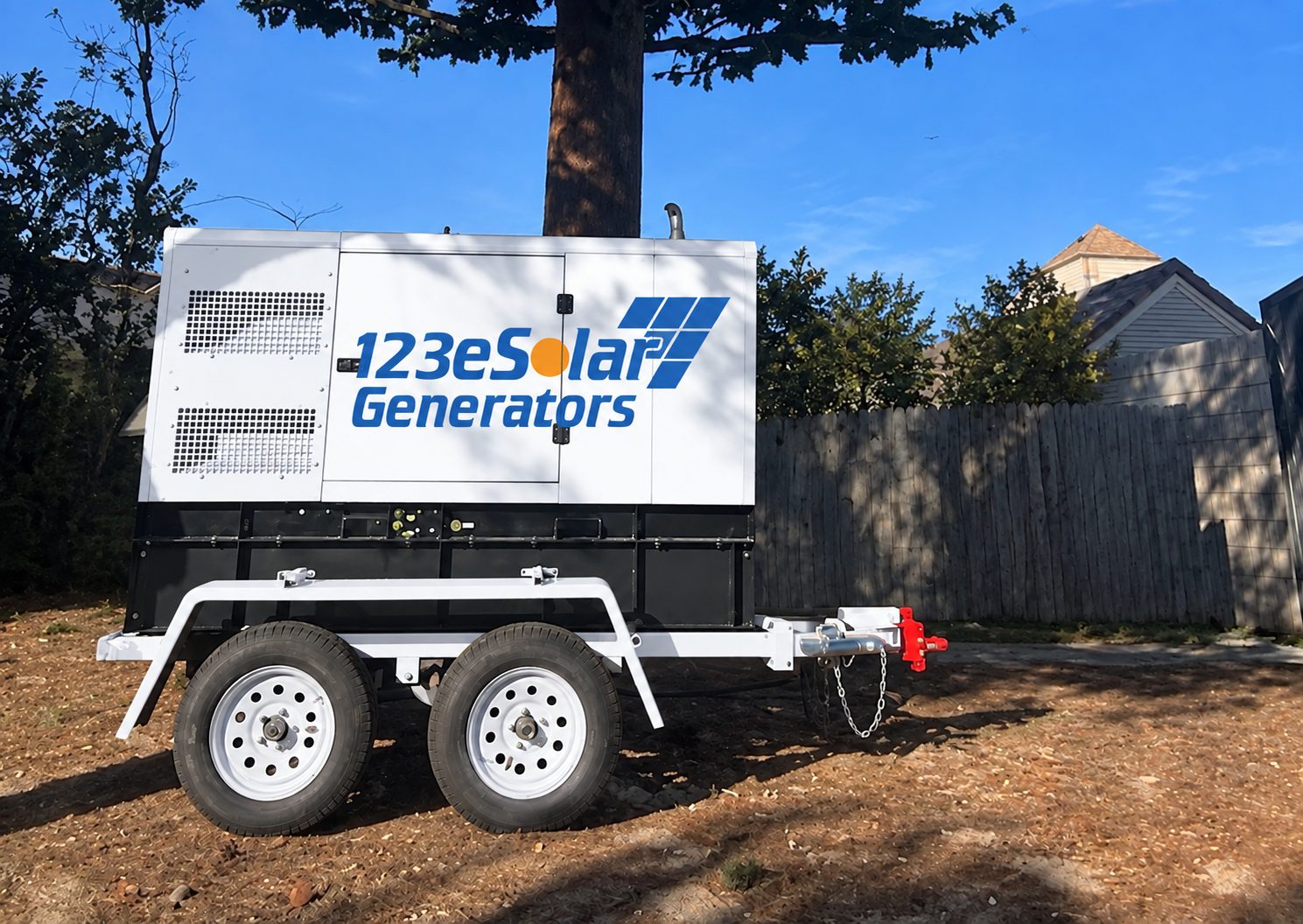
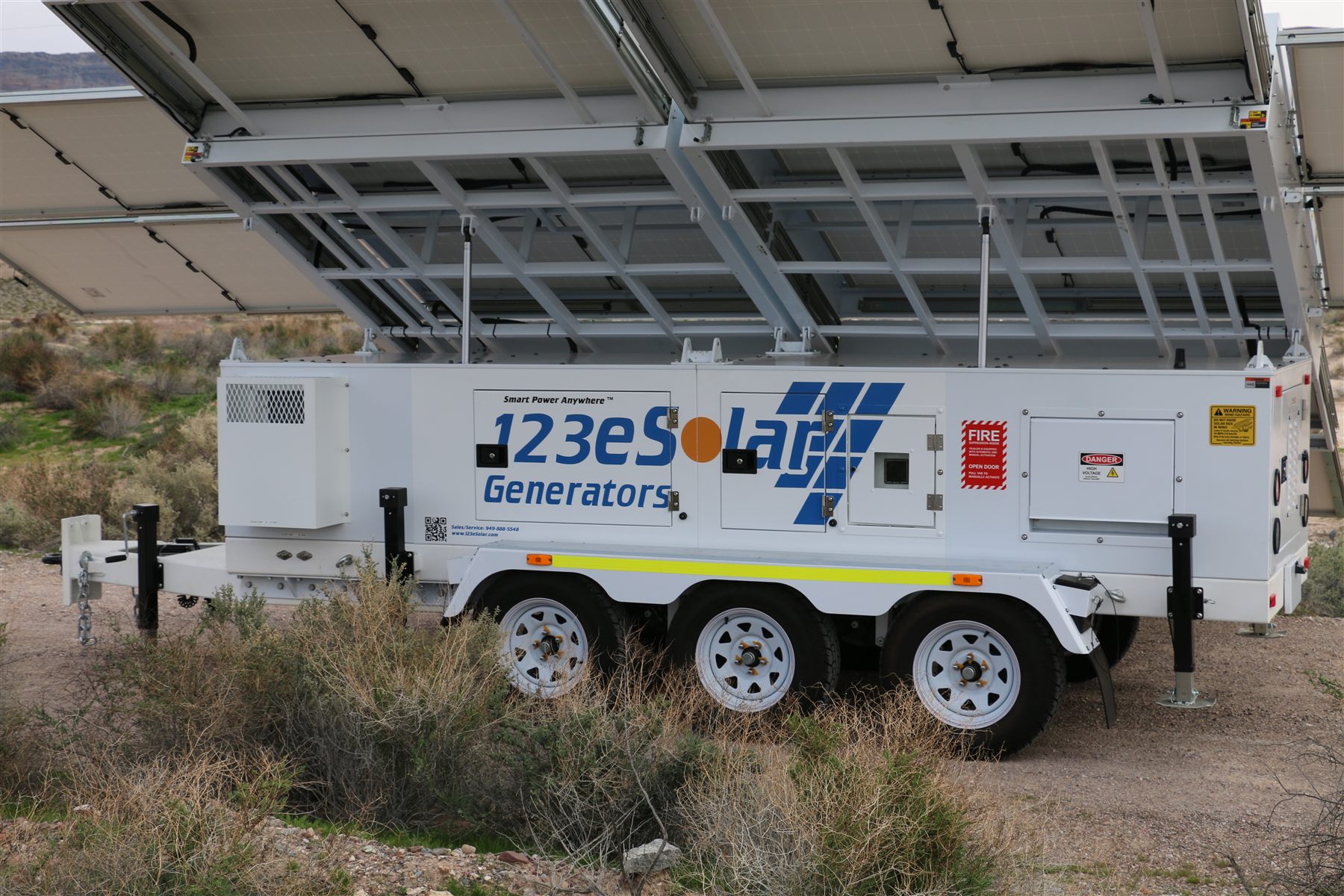
A new cell site is often ready to go on air before utility power reaches it, and until it does, a temporary diesel generator runs it around the clock. 123-STG-71S62 is the long-endurance Tri-Brid™ for that job: a sixteen-panel solar array, 22.8 kWh of lithium storage and a 9 kW diesel generator on one trailer, built for remote sites where every refuelling trip is a truck, a driver and a day.
The 7.36 kW array produces 31.6 kWh on an average day — enough that below 1.32 kW the site runs on sun and battery alone with the engine off. Continuous output is rated at 9 kW, set by the generator; the battery holds up to 12 kW for short peaks, with surges to 24 kW for motor starts.
Above the solar break-even the generator runs only to make up what the sun and the bank cannot. At a steady 6 kW the engine runs 12.81 hours a day where the 40 kW generator telecom sites use for temporary power would run all 24, and a full 120-gallon tank lasts 12.03 days between refuels against 7.92 for the 40 kW alone — 9.48 gallons a day instead of 16.8. At 4 kW the tank lasts 20.63 days. Both engines are read by the same fuel rule: their own published figures, held at the lowest one below it. That is the figure that decides how often a remote site has to be visited, and it is what makes this the cost-effective way to keep the site on air. The engine is certified to EPA Tier 4 Final.
Output is 120/240 V or 120/208 V at 50/60 Hz with a 5 ms transfer, and the machine is rated for operation from -4 to 140 °F (-20 to 60 °C). Size a continuous load at or under the 9 kW rating; the table below shows exactly what happens above it.
Features and benefits
- Sixteen 460 W panels, 7.36 kW — Light loads burn no fuel at all.
- 9 kWe diesel with a 120-gallon tank — 12 days between refuels at 6 kW, the longest interval in the line.
- 22.8 kWh lithium iron phosphate bank — Motor starts and short peaks never lean on the engine.
- EPA Tier 4 Final engine — Ready for sites that specify Tier 4 Final equipment.
Performance
Performance across the load range.
Zero to 12 kW. Rated for 9 kW continuous — loads above that are shown in red.
engine hours per daydiesel, US gallons per daythe array carries the whole dayrated continuous output
| Loadcontinuous, 24 h | Solar generationthe array, per day | Battery only | Daily drawload × 24 h | After solar | Days of autonomy | Generator | Engine runsa day × each | Charge setting | Days on a tank |
|---|---|---|---|---|---|---|---|---|---|
| 1.32 kWsolar break-even | 31.6 kWh | 8.34 h / 11.68 h | 31.6 kWh | covered | indefinite | 0 h/day | none | 141 A | — |
| 2 kW | 31.6 kWh | 5.5 h / 7.7 h | 48 kWh | 16.4 kWh | 0.67 days | 1.93 h/day | 1.1 × 1.8 h | 137 A | 79.7 days |
| 4 kW | 31.6 kWh | 2.75 h / 3.85 h | 96 kWh | 64.4 kWh | 0.17 days | 7.47 h/day | 3 × 2.5 h | 98 A | 20.6 days |
| 6 kW | 31.6 kWh | 1.83 h / 2.57 h | 144 kWh | 112.4 kWh | 0.1 days | 12.81 h/day | 3.1 × 4.1 h | 59 A | 12 days |
| 8 kW | 31.6 kWh | 1.38 h / 1.93 h | 192 kWh | 160.4 kWh | 0.07 days | 17.97 h/day | 1.5 × 12.4 h | 20 A | 8.6 days |
| 10 kW | 31.6 kWh | 1.1 h / 1.54 h | 240 kWh | 208.4 kWh | 0.46 days | 24 h/day | — | 0 A | 6.4 days |
| 12 kW | 31.6 kWh | 0.92 h / 1.28 h | 288 kWh | 256.4 kWh | 0.15 days | 24 h/day | — | 0 A | 6.4 days |
Every load here runs continuously, and the day is 24 hours — daily draw is the load × 24 h, so 2 kW is 48 kWh. A load that runs an 8-hour shift draws a third of the figure shown and lasts three times as long. Battery-only hours are given at both state-of-charge settings. Solar is a daily energy offset, not an instantaneous power match — over a day it balances, within a day it is not a guarantee of cover.
The engine starts at 30% state of charge (a 70% depth of discharge) and stops at 80%, putting 11.4 kWh back into the bank on each run while it carries the load. The engine runs a day follow from that at each load.
Case study
Against the 40 kW generator running alone.
At 6 kW around the clock, the 40 kW generator telecom sites use for temporary power would carry the site alone at 15% of its rating, 24 hours a day. 123-STG-71S62 runs its engine 12.8 hours a day — 47% fewer engine hours — and burns 44% less diesel: 9.5 US gallons a day against 16.8 US gallons, and 12 days between refuels against 7.9 days.
PDF The full engineering sheet with this case study, to print.
| Loadcontinuous, 24 h | 40 kW alonediesel a day, engine 24 h | Days on a tank40 kW alone | This systemengine hours a day | Diesel a daythis system | Days on a tankthis system | Engine hours saved | Diesel saved |
|---|---|---|---|---|---|---|---|
| 2 kW5% of the 40 kW | 16.8 gal | 7.9 days | 1.93 h | 1.4 gal | 79.7 days | 92% | 91% |
| 4 kW10% of the 40 kW | 16.8 gal | 7.9 days | 7.47 h | 5.5 gal | 20.6 days | 69% | 67% |
| 6 kW15% of the 40 kW | 16.8 gal | 7.9 days | 12.81 h | 9.5 gal | 12 days | 47% | 44% |
| 8 kW20% of the 40 kW | 16.8 gal | 7.9 days | 17.97 h | 13.3 gal | 8.6 days | 25% | 21% |
The 40 kW generator carries the load alone, 24 h a day with no sun and no battery, on its own 140 gallon tank (133 usable). Both engines are read by the same rule: their own published fuel figures, a straight line between them, and below the lowest published point that point’s burn — for the 40 kW, 25% of its rating. No lighter-load figure is invented for either engine. This system’s figures are the performance table above.
Size it for your site
Your load, on 123-STG-71S62.
Most sites swing between a low and a high. Enter both, and the hours a day spent at the high, and the figures follow your day rather than a flat worst case; add your diesel price for the fuel bill. The load is yours — nothing is assumed until you enter it, and nothing that names you is kept; the PDF button builds the engineering sheet from the figures you enter.
PDF The engineering sheet, with page two worked out for your load.
| Held flat at your high24 h at the high load | Your dayhigh and low, as entered |
|---|
Read from the performance table above: engine hours and fuel follow the day's energy, so your day is read at its average load; solar is the published daily figure; battery-only hours are the published bank at your high load. A load held for 24 hours is the worst case at that level. With no days entered it runs indefinitely; a week and a year are your day repeated, at the same sun.
Gallery
On site and on the road.


Applications
Where this configuration is deployed.
Related deployments
This configuration, proven in the field.
Case study · TelecomVerizon’s cell on wheels at MetLife Stadium, powered off gridFor a New York Giants Monday Night Football game, a 123eSolar Tri-Brid™ powered Verizon’s Cell on Wheels in the stadium parking lot — solar, battery storage and standby diesel, with no utility connection.Read the case study