
Continuous Power Without Continuous Diesel Operation
A grid outage can leave a site dependent on temporary or backup power for days, months, or indefinitely. Communications, water systems, monitoring equipment, temporary facilities, and other essential operations may still require electricity 24 hours a day.
- Load
- 5.7 kW, 24 hours a day
- Sun
- 5.2 peak-sun hours a day, annual average
- System
- 123-SG-7S82-40, solar and battery platform with a standalone 40 kW diesel
- Engine runtime
- 24 h a day on the generator alone, 5.8 h a day as one system
- Basis
- A representative application, calculated for these conditions
A diesel generator can carry the load, but a generator-only solution may require the engine to run continuously—24 hours a day and 8,760 hours a year.
Some sites cannot accept that much engine operation. Fuel deliveries may be difficult, service visits may be expensive, or noise and exhaust may make continuous generator use impractical.
123eSolar provides another approach: combine solar generation, battery storage, intelligent controls, and diesel backup into one coordinated off-grid power system.
Keep the Power. Reduce the Engine Hours.
A properly configured 123eSolar system uses solar and stored energy to carry the load for much of the day. The diesel generator operates when necessary to replace the energy the solar array cannot provide.
The generator remains available for continuity, but its engine does not need to run around the clock.
Consider a steady 5.7 kW load operating 24 hours a day at a site receiving an annual average of 5.2 peak-sun hours per day.
For those conditions, the 123-SG-7S82-40 is calculated to reduce diesel-engine runtime from 24 hours a day to 5.8 hours a day.
That represents:
- A 76% reduction in diesel-engine runtime
- Approximately 6,645 fewer engine hours per year
- About 18 hours each day without a running engine
These results apply to the stated load, available sunlight, and system configuration. Every site must be evaluated using its own operating requirements.
One System, Three Energy Sources
The 123-SG-7S82-40 pairs a mobile solar-and-battery platform with a standalone 40 kW diesel generator.
The solar platform includes 16 panels, 7.36 kW of solar capacity, 30.4 kWh of battery storage, and 12 kW of continuous inverter output.
Each part has a defined role.
Solar produces energy when sunlight is available. The battery stores and delivers energy between solar production and generator operation. Intelligent controls coordinate the available sources. The diesel generator supplies the remaining requirement when solar and stored energy are insufficient.
The objective is not to eliminate diesel from an application that requires dependable backup. It is to prevent the diesel engine from operating unnecessarily.
Fewer Operating Demands at the Site
In this representative application, annual diesel-engine operation falls from 8,760 hours to approximately 2,115 hours.
Fewer engine hours slow the accumulation toward inspections, oil changes, and other hour-based service intervals. Exact maintenance savings depend on the selected generator, its service schedule, and local service costs. The reduction in operating hours, however, is direct and measurable.
Under the same modeled conditions, the combined system uses approximately 3,300 fewer gallons of diesel per year than the 40 kW generator operating alone.
It also requires about 25 fewer refueling trips per year. The calculated interval between refueling increases from approximately 7.9 days to 17.1 days.
Fewer fuel deliveries and service visits reduce the effort required to keep essential equipment operating, particularly at remote or difficult-to-access locations.
Built for Field Service
The diesel generator is mounted on its own trailer, separate from the solar-and-battery platform. It can be serviced or exchanged without disturbing the solar side of the system.
This modular arrangement keeps the generator available for the work it does best while allowing the solar and storage equipment to remain an independent, serviceable unit.
Configure Power for Your Site
A grid outage is only one reason dependable utility power may be unavailable. Delayed utility connections, temporary infrastructure, remote operations, and emergency response can create the same requirement: maintain a continuous load without operating a diesel engine continuously.
Every result depends on the load, operating schedule, location, available sunlight, and continuity requirement.
Start with what must remain powered. Use the 123eSolar sizing tool to model your site, then request an engineering sheet for a solar, storage, and backup configuration designed around your requirements.
PDF This page with the 123-SG-7S82-40 engineering sheet, to print.
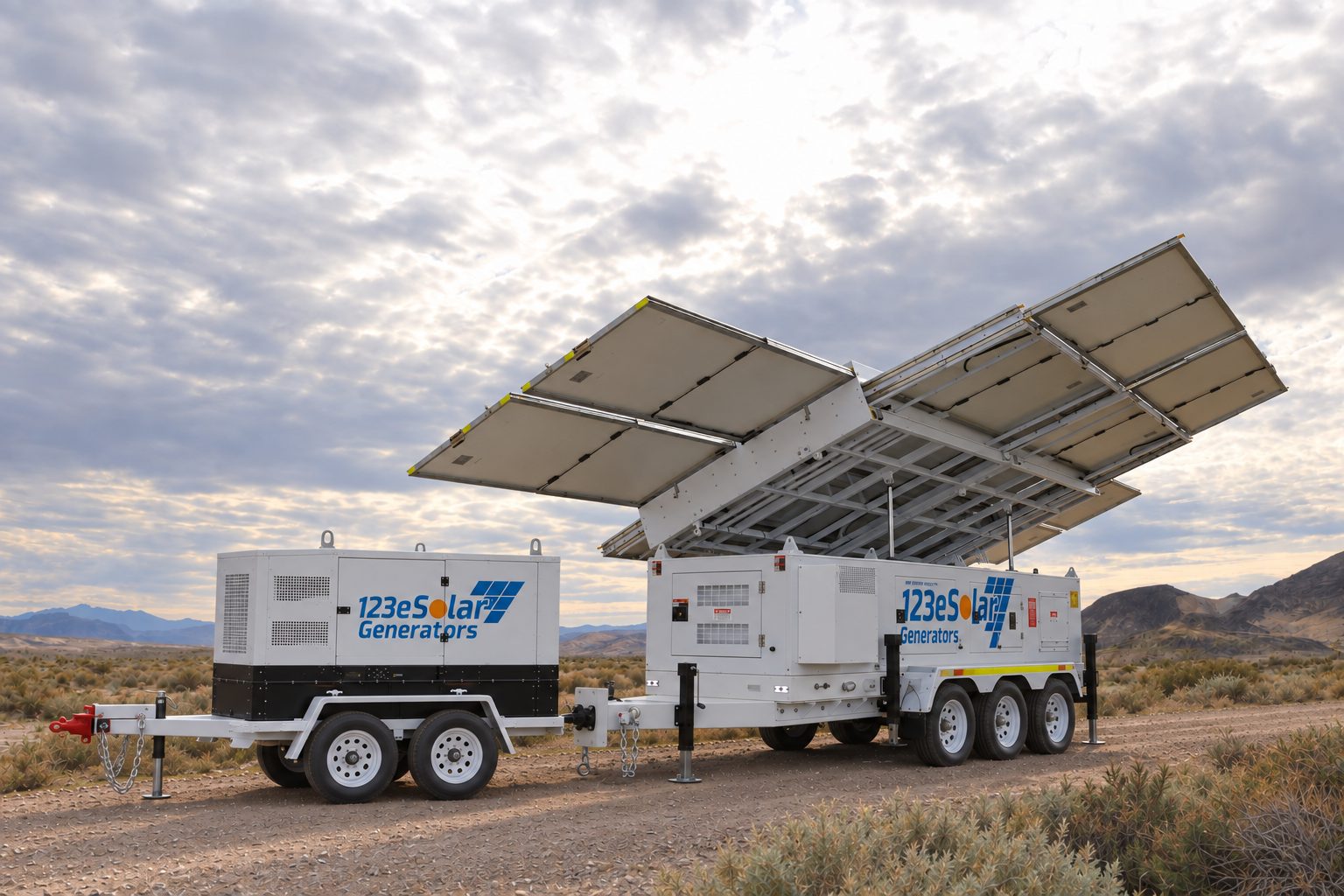 The system123-SG-7S82-40The sixteen-panel solar trailer with a standalone 40 kW diesel beside it: 15.9 days between refuels at 6 kW.View the system
Configure power for your site.
Start with what must remain powered.